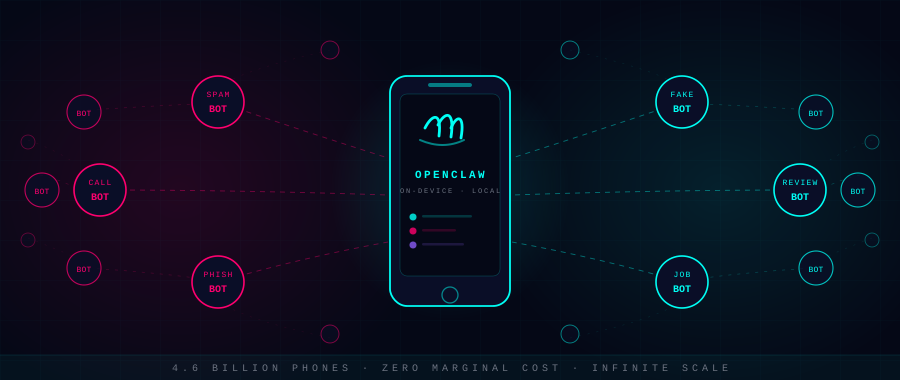
The Pocket-Sized Bot Factory
Something quietly crossed a threshold in late 2025. Open-weight AI models—compact enough to run entirely on a consumer smartphone, no cloud required—became genuinely capable. Tools like OpenClaw and similar on-device inference engines let anyone with a mid-range Android or iPhone run a conversational AI agent locally, at zero marginal cost per query, with no API key, no rate limits, and no usage logs.
For researchers and power users, this was a breakthrough. For the internet at large, it was the opening of a trapdoor. Because there is another word for a capable AI agent running on a device with a persistent internet connection, a phone number, an email address, and a contact list: a bot node.
The internet's spam problem didn't scale with server farms. It scaled with pocket computers. We handed every person on Earth a bot factory and called it a phone.
About 4.6 billion people worldwide use mobile internet on their own device—roughly 57% of the global population. Even a tiny fraction of that base, running even partially-automated AI workflows, produces an output volume the internet has never encountered. This essay examines what that looks like, where it hits hardest, and what you can actually do about it.
Why On-Device AI Changes Everything
Previous waves of spam required infrastructure: a botnet of compromised machines, a rented server, a purchased email list, a CAPTCHA-solving service. Cost was the friction. Running mass spam campaigns required either money or technical sophistication. Neither is trivially abundant.
On-device AI inverts this. When the intelligence lives on the phone, the barriers collapse:
- No API costs. Local inference means no per-token billing. A model running on your phone generates ten thousand messages at the same cost as one.
- No detection via API abuse. Cloud providers watch for anomalous usage patterns. Local models have no provider to alert.
- Authentic device fingerprints. Messages come from real phones with real numbers, real IP addresses, real carrier signals—not data centers. Filters trained on server-farm patterns are partially blind to this.
- Persistent connectivity. Phones are always on. A local agent can drip-send content continuously, mimicking human pacing to evade rate-limit heuristics.
- Personalization at scale. On-device models can read your contact list, pull public social profiles, and generate messages that reference real details about recipients— making them feel human-written.
Traditional spam filters were built to catch infrastructure-scale patterns: known-bad IPs, bulk send rates, identical message fingerprints. On-device AI produces varied, low-volume, personalized content from legitimate device identifiers. Most existing defenses weren't designed for this.
The Signal Collapse: How the Internet Breaks
The internet's value has always rested on a single assumption: that most content was produced by humans, and that finding useful signal in the noise was possible with effort. Search worked because pages were written by people for people. Reviews worked because they reflected genuine experience. Job boards worked because listings represented real openings and applications represented real candidates.
On-device AI at mobile scale breaks every one of these assumptions simultaneously.
Search and the Web Content Crisis
SEO spam already blights search results, but it required dedicated server infrastructure and specialized tooling. On-device AI makes content generation a background task on any smartphone. A single moderately motivated actor can generate thousands of unique, topically coherent articles per day—each with varied phrasing, different structure, plausible outbound links—and publish them across a network of cheap or free hosting services.
Search engines respond by tightening ranking signals toward sites with established domain authority, verified authorship, and engagement patterns. The result is a paradox: the open web becomes less discoverable, while closed platforms—Reddit, LinkedIn, Discord—temporarily become the last refuges of human-originated content. Until they aren't.
Social Networks and Manufactured Consensus
When millions of phones can generate contextually aware replies, likes, shares, and reactions, the social proof signals that platforms use to surface content stop meaning what they used to mean. Trending topics can be seeded. Comment sections can be flooded with synthetic agreement or synthetic outrage. Reviews on products, restaurants, and apps can be fabricated at volumes that drown out authentic feedback.
The insidious part is that the content isn't wrong or obviously fake—it's just not human. It reads correctly. It engages with the right keywords. It arrives at the right frequency. The manipulation is structural, not textual.
The Job Market Collapses into Noise
Job boards are perhaps the clearest early casualty. On-device AI means that any individual can fire off hundreds of personalized applications per day with zero additional effort. A single motivated job seeker with an AI agent on their phone becomes, from a recruiter's perspective, indistinguishable from a small staffing firm—except the output is infinite and effectively free.
The reverse is equally damaging. Fake job postings generated by AI—scam listings, data-harvesting forms disguised as applications, phantom recruiters—multiply at the same rate. The job market becomes a two-sided bot war: AI-generated applications chasing AI-generated listings. The humans in the middle—real candidates, real hiring managers—spend most of their time in noise.
| Attack Vector | Pre-On-Device AI | Post-On-Device AI | Human Cost |
|---|---|---|---|
| Spam email | Generic, detectable bulk sends | Personalized, low-volume, from real devices | Inbox trust collapses |
| Job applications | Hundreds/month per person (effort-limited) | Thousands/day per person (agent-automated) | Recruiters stop reading; qualified candidates get lost |
| Fake job postings | Manual creation, limited scale | Auto-generated, geo-targeted, refreshed continuously | Job seekers waste time; data harvested |
| Robocalls | Scripted, recognizable patterns | Conversational, adaptive, personalized by caller ID data | Phone as communication tool becomes unusable |
| Review platforms | Farms of human workers | Single device generating varied, locally-flavored reviews | Social proof becomes meaningless |
| Web content | Server-hosted content mills | Distributed generation from personal devices at zero cost | Search results degrade; open web visibility shrinks |
The Recursive Threat: Bots That Build Bots
The signal collapse described above assumes human operators behind each bot — a person running an on-device AI to pump out content. The more disturbing trajectory is what happens when the humans step back entirely.
An on-device AI agent with the right tooling can do more than generate messages. It can create new digital identities: register email addresses through open APIs, obtain VoIP numbers for SMS verification, complete CAPTCHA challenges via third-party solving services, and build out social profiles over weeks of low-volume activity. Each new identity can run its own local AI agent. Each of those agents can spawn more identities.
A virus needs a host. A synthetic bot only needs a phone number and twelve minutes. The next generation seeds itself.
The math is unforgiving. If a single originating agent spawns three synthetic personas, and each of those spawns three more, the network expands as 3n. By generation 10, a single "patient zero" device has seeded 59,049 active bot identities. By generation 15: over 14 million. These aren't zombie computers hijacked from unsuspecting users — they are intentionally constructed synthetic entities, each with a plausible history, each capable of independent operation.
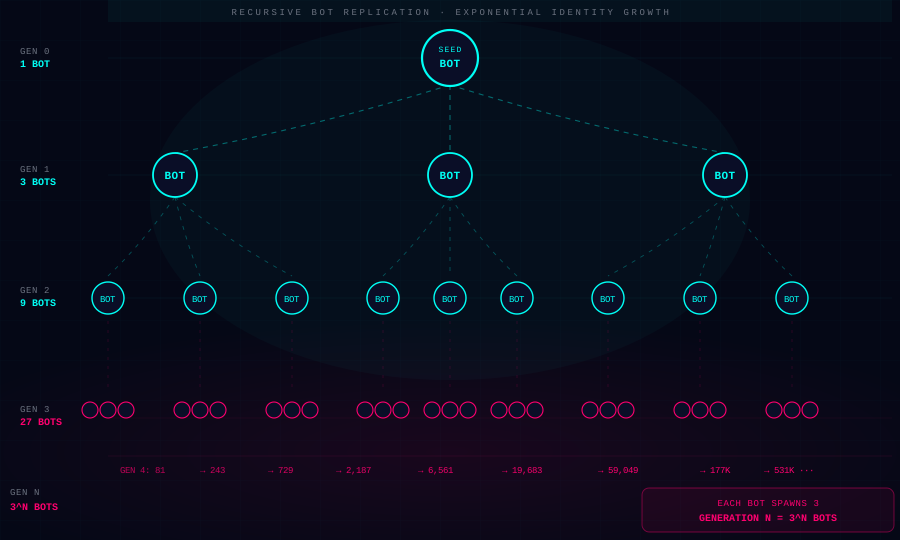
This isn't speculation. Coordinated influence operations on social media have already demonstrated the anatomy: a small number of seed accounts, built patiently over months, spawning a larger network of amplifying accounts, each reinforcing the others' content to fool algorithmic ranking systems. On-device AI doesn't invent this playbook — it removes the human labor cost that previously kept it rare.
The cascading effects compound across systems. Bot-generated job listings attract bot-generated applications. Bot-generated reviews influence bot-generated purchasing recommendations. Bot-generated social content seeds bot-generated news summaries. Each layer makes the next layer harder to distinguish from authentic human activity — and harder to trace back to an origin.
Unlike a biological virus, there is no natural death rate for a synthetic bot. Accounts don't expire. Identities don't deteriorate. A bot spawned in 2026 is just as active and indistinguishable in 2030 unless a platform actively detects and removes it — a cat-and-mouse game that platforms are currently losing. The network grows faster than the cleanup crews can run.
The Offline Bleed: When Bots Come for Your Daily Life
The impact doesn't stay behind screens. On-device AI with access to voice synthesis, contact data, and persistent connectivity crosses into physical channels.
Bot Phone Calls: The Voice Turing Test Fails
Voice cloning and real-time speech synthesis have reached a point where a locally-run model can hold a plausible two-minute phone conversation without a human on the other end. Combined with scraped phone directories and caller ID spoofing, the result is robocalls that don't sound like robocalls. They ask clarifying questions. They respond to objections. They remember what you said thirty seconds ago.
The tell-tale signs of fake calls—unnatural pacing, canned responses, weird silence gaps—are disappearing. Within the next two years, distinguishing an AI caller from a human will require deliberate, non-standard conversational challenges that most people aren't trained to deploy.
Personalized Phishing: Your Name, Your Context, Your Data
Phishing used to be generic because personalization was expensive. "Dear Customer" emails announcing a problem with your account were crafted once and sent to millions. On-device AI changes this: a model with access to your scraped LinkedIn profile, your public social posts, and your email domain can draft a message that references your employer, your recent activity, your plausible concerns—and do it for every person on a list of ten thousand, each message unique.
The cognitive heuristic that "if it knows things about me, it's probably real" becomes a liability rather than a safety net.
Fake Professional Networks and Phantom Colleagues
LinkedIn, Slack, and professional forums are increasingly populated by synthetic personas—accounts built over weeks or months, with plausible histories, consistent posting patterns, and realistic engagement behavior. These aren't the crude bot accounts of a decade ago. They're patient infiltrations: the fake recruiter who builds credibility for three months before pitching a scam, the synthetic peer who worms into a private group and harvests internal discussions.
The internet was built for a world where generating content at scale required either labor or money. Neither constraint holds anymore. We are entering a period where the cost of producing convincing fake human output approaches zero. Every institution that relied on volume as a proxy for legitimacy—platforms, hiring systems, email filters—must rebuild on different foundations.
The Near-Future Internet: What's Coming
The trajectory from here is not linear degradation. It's likely to move in two phases.
Phase 1: The Noise Plateau (2026–2027)
In the near term, most platforms will respond reactively. Better behavioral fingerprinting, cryptographic verification of device provenance, tighter onboarding friction, and increased reliance on social graph signals ("people you actually know vouch for this account") will blunt the most obvious abuse vectors. The open web will become noisier while walled gardens— platforms with verified identity requirements—temporarily hold signal quality.
This phase is already underway. The uncomfortable reality is that the platforms with the most friction—the ones that require real-world verification, phone numbers, even government ID in some contexts—will survive this era better than open, permissionless systems.
Phase 2: The Bifurcated Internet (2028+)
Longer term, the internet likely bifurcates. On one side: a high-trust layer requiring verifiable human identity, probably anchored to some form of cryptographic attestation or institutional credential. On the other: the open web, increasingly unnavigable without AI-assisted curation to filter the noise—which itself creates new dependency and control vectors.
Email, as currently architected, probably doesn't survive this transition as a reliable communication medium for strangers. Phone calls to unknown numbers are already nearly useless. The infrastructure of impersonal outreach—cold email, cold calling, public job boards—will either require identity verification layers or collapse into near-total noise.
The internet won't disappear. It will stratify. Signal will live inside verified networks. Everything outside will be treated as noise until proven otherwise.
What You Can Do Now: Practical Defense
You cannot fix the structural problem individually. But you can dramatically reduce your personal exposure to bot noise, both online and in your daily life. The core principle is the same throughout: raise the cost of contacting you, and route around channels that bots have already colonized.
Securing Your Inbox
- Use a strict allow-list model. Tools like HEY, Fastmail, or Gmail's aggressive filtering can route all unrecognized senders to a separate folder. Read that folder once a week, not once an hour.
- Use unique email aliases per service. SimpleLogin, AnonAddy, or Apple's Hide My Email create per-service addresses. When spam arrives on one alias, you know exactly which service sold your data—and you kill the alias, not your primary account.
- Never unsubscribe from unsolicited email. Unsubscribe links confirm your address is live. For email you didn't opt into, mark as spam and let the filter learn.
- Treat any email requesting action with extraordinary skepticism. Verify through a second channel—not a link in the email, not a phone number in the email—before acting on any financial, credential, or identity request.
Reclaiming Your Phone
- Enable silence unknown callers. Both iOS and Android have native settings to silence calls from numbers not in your contacts. They go to voicemail. Real callers leave one.
- Use a call-screening service. Google's Call Screen (Android) or apps like Hiya or Robokiller intercept and screen calls before they reach you. Many bot calls hang up immediately when greeted by a screening prompt.
- Register on Do Not Call lists. In the US, the FTC's Do Not Call Registry doesn't stop scammers, but it reduces legitimate marketing calls and shrinks the noise floor slightly.
- Never confirm your identity on an inbound call. Any legitimate institution that called you can be called back via the number on their official website. If a caller says they're from your bank, hang up and call the bank directly.
- Establish a safe word with family. Voice cloning can impersonate people you know. A pre-arranged word or phrase that a synthetic voice is unlikely to know provides a human verification layer that technology can't easily replicate—yet.
Navigating the Job Market
- Prioritize warm introductions over cold applications. If most applications are bot-generated, your competitive advantage is demonstrably human: a referral from someone the hiring manager knows personally.
- Verify companies independently before applying. Before submitting any personal information, confirm the company exists via LinkedIn, Crunchbase, or news coverage. Look for employees you can verify on LinkedIn. A posting with no verifiable employees is a red flag.
- Never pay for anything in a job process. Legitimate employers don't charge application fees, training fees, or equipment deposits. This hasn't changed—AI has just made the fake job more convincing.
- Use a separate email for job applications. Keep it clean. When it gets flooded with synthetic recruiter spam—and it will—you can reset it without affecting your real correspondence.
Reducing Your Attack Surface Online
- Audit your public data footprint. Services like DeleteMe or Incogni will remove your data from people-search aggregators—the primary data source for personalized phishing and spam targeting. This is worth paying for.
- Lock down social profile visibility. Public profiles on LinkedIn, Facebook, and Instagram provide the raw material for personalized social engineering. Limit visibility to confirmed connections where possible.
- Be skeptical of new connections from people you don't recognize. Synthetic personas have realistic-looking histories. Before accepting a professional connection request, check whether you have mutual connections who can verify them.
- Use a password manager and hardware key. Most phishing succeeds not through raw deception but through credential reuse. Strong, unique passwords per service and a hardware security key eliminate most credential-based attack vectors regardless of how convincing the phish is.
Filtering Bot Noise from Your Information Diet
- Shift from algorithmic feeds to curated subscriptions. RSS readers, newsletters from authors you've manually selected, and Discord communities with active human moderation are harder for synthetic content to colonize than open social feeds.
- Treat reviews as degraded signal. For high-stakes purchases, find communities where members have verifiable histories—specialized forums, subreddits with active moderation, professional networks. Aggregate star ratings on open platforms are already approaching noise.
- Develop a personal network you can call on. The highest-value information channel is always a trusted human who has first-hand knowledge. Invest in relationships that let you text a real person and ask "have you actually used this?" The value of that connection only increases as ambient information degrades.
The heuristics that served you for thirty years of internet use—volume as proof of legitimacy, personalization as proof of humanity, professionalism of appearance as proof of trustworthiness— are all now forgeable at scale. The replacement heuristic is simpler and older: trust people you can verify, through channels they control, via introductions from people you already trust. The internet is reverting to something that looks more like a small town than a global broadcast medium. Act accordingly.
The Asymmetry We Have to Accept
There is no individual solution to a structural problem. You can reduce your personal exposure significantly with the steps above, but you cannot opt out of living in a world where the background radiation of synthetic content is rising. The open web will become harder to navigate. Email from strangers will become less trustworthy. Phone calls from unknown numbers will approach zero legitimate signal.
These aren't hypothetical future states. They are already the present for anyone paying attention. The difference is that on-device AI at mobile scale accelerates the timeline from "noticeable degradation" to "functional collapse" for the channels that haven't already adapted.
What changes is the response. The internet's first era was defined by openness and permissionless access. Its next era will be defined by the infrastructure of trust: verified identity, accountable channels, and the premium placed on genuine human relationships over ambient digital noise.
4.6 billion phone-connected humans represent the largest potential communication network ever built. The tragedy of the bot flood is not that AI is powerful—it's that we are using that power to make it harder for humans to talk to each other. Every signal drowned in noise is a connection that didn't happen, an opportunity that didn't form, a person who withdrew further from the open commons of the internet.
The question isn't whether AI will transform the internet. It already has. The question is whether we build the trust infrastructure fast enough to keep human communication viable inside it.
Start with your own channels. Raise the barrier. Invest in the relationships you can verify. And when someone you don't know reaches out through a channel you don't control, treat it as noise until proven otherwise. That's not cynicism. In 2026, it's just calibration.